Aragonese speech to text

Prepare a transcript draft from Aragonese audio or video, then review the text alongside your recording.

An account is required. Choose your file in the app after signing up or signing in.

Start with your recording

Continue to Speechyou to upload your Aragonese audio or video.

or drop a file here

MP3, WAV, M4A, MP4 and more

Continue to signup. Your file stays on your device; choose it again in the app after creating your account.

No file is uploaded on this page.

Make more of your transcript

Work with your recording after transcription: review the text, find the passage you need and prepare it for the next step.

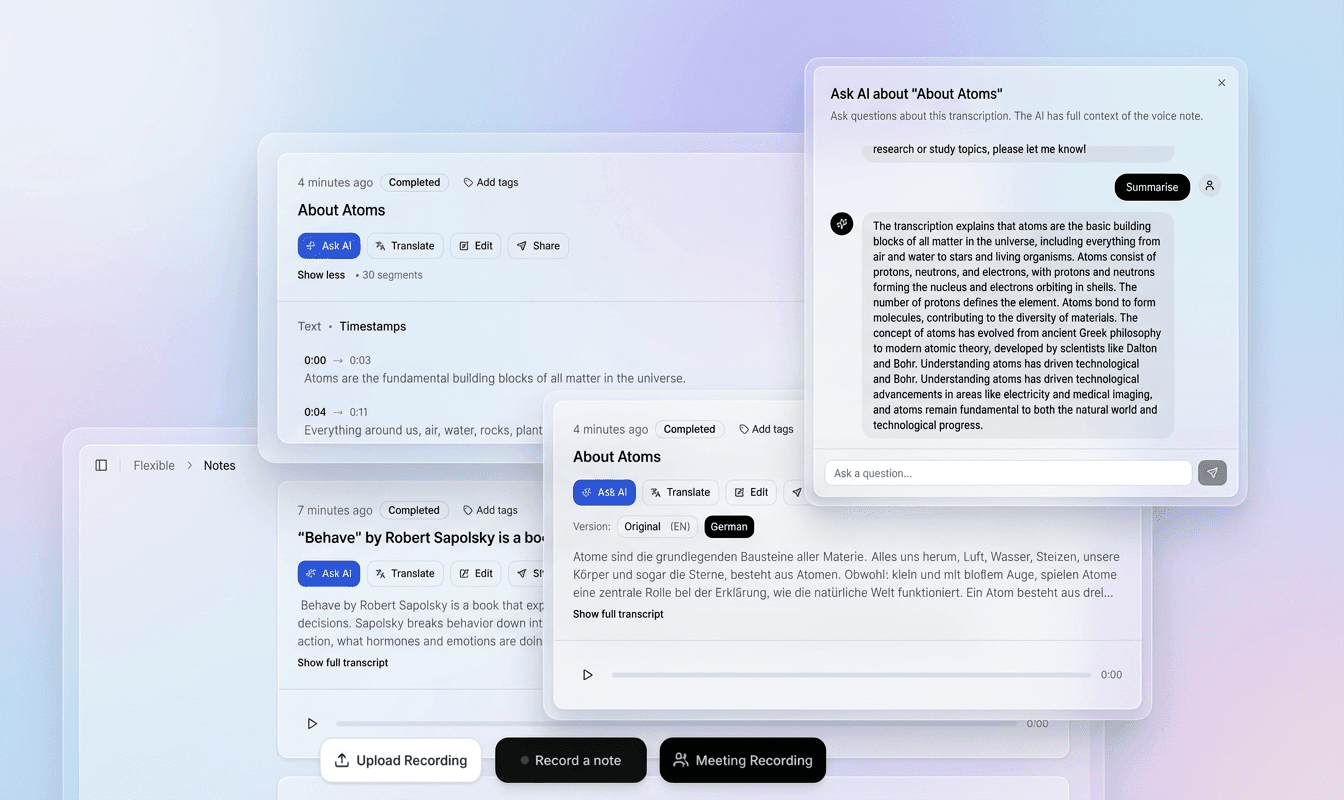
Speechyou transcript interface showing timestamps, editing and AI chat
Speechyou product screenshot with example content. Upload and transcription take place in the app after signing in.

Review text with timestamps

Use the recording and timestamped text together to check names, unfamiliar words and speaker changes in context.

Edit before you publish

Correct the transcript in the editor, refine segments and prepare a version that fits your document or video.

Keep the useful parts

Export plain text, structured data or subtitle files. Use the transcript for notes, research, captions and follow-up work.

From a recording to a useful transcript

  1. 01

    Create your account

    Choose a file above to continue to signup. Your recording stays on your device at this step.

  2. 02

    Upload and select the language

    In the app, choose your file again, select its spoken language and model, then start transcription.

  3. 03

    Review, then export

    Check the draft against your recording, correct the text and timing, then export the format you need.

Varieties and writing conventions

Regional speech and spelling conventions matter. Identify the variety in your recording and check an excerpt before committing a larger project.

Western Aragonese
Spoken in the western part of Aragon, including areas like Ansó, Echo, and Chistau. Features distinct vocabulary and pronunciation compared to central varieties.
Central Aragonese
The most widespread dialect, used in the central Pyrenees and parts of the pre-Pyrenees. It serves as a basis for the standard written norm.
Eastern Aragonese
Found in the eastern valleys, such as Ribagorza and Benasque. It shows influences from Catalan and has unique phonetic traits.
Southern Aragonese
Spoken in the southern areas of the historical Aragonese territory, now largely replaced by Spanish but with some residual features.

What to check in your transcript

Prepare an Aragonese draft with the spoken variety and project spelling convention documented for the reviewer.

Results depend on the recording, selected model and language variety. Review names, specialist terms and unclear passages before sharing or publishing.

Local variety

Record the variety used by the speakers so that local forms are not replaced simply because another spelling is more familiar.

Writing convention

Check the final text against the convention agreed for the project, particularly recurring names and inflected forms.

Check the Latin text

Review accents and language-specific letters. Check that similar-looking Cyrillic characters have not entered Latin words when editing or copying text.

The details that need attention

What to listen for when reviewing the first draft.

Dialectal Variation

Aragonese has several dialects with differing pronunciations and vocabularies. Regional Aragonese pronunciation and vocabulary need review in their own context. When working with Western Aragonese, Central Aragonese, Eastern Aragonese, keep the speaker’s wording and check unfamiliar forms with a fluent reviewer.

Limited Training Data

As a minority language, Aragonese has scarce acoustic and text corpora. Check Aragonese spelling against the recording and the writing convention used by your project. Review names, diacritics and unfamiliar word forms before exporting; a page’s script label does not replace checking the actual written output.

Orthographic Standardization

There are competing orthographic norms (e.g., the Huesca norm, the SLA norm). Speechyou supports the most widely accepted standard, while allowing flexibility for user preferences.

Code-Switching with Spanish

Aragonese speakers often mix Spanish terms. For mixed-language Aragonese recordings, mark each language change during review and check borrowed words and names against the audio. Correct any passage that has been normalized into the wrong language.

Uncommon Phonemes

Aragonese retains Latin-derived phonemes like /ʃ/ (x) and /tʃ/ (ch) that are rare in Spanish. Record the variety used by the speakers so that local forms are not replaced simply because another spelling is more familiar. Check the final text against the convention agreed for the project, particularly recurring names and inflected forms.

Work with your recordings

Practical ways to turn a recording into material you can search, edit and reuse.

Preserving Oral History

Record the variety used by the speakers so that local forms are not replaced simply because another spelling is more familiar. Check the final text against the convention agreed for the project, particularly recurring names and inflected forms.

Aragonese Podcasts & Radio

Generate accurate subtitles and transcripts for podcasts and radio programs in Aragonese, making content accessible to a wider audience.

Subtitling Local Videos

Add Aragonese subtitles to regional YouTube videos, documentaries, and cultural content to promote the language online.

Academic Research

Transcribe field recordings, lectures, and linguistic research materials in Aragonese for analysis and archiving.

Accessibility for Deaf & Hard-of-Hearing

Work from a saved Aragonese audio or video recording in the online app. Review the resulting transcript and export SRT or VTT captions for your video; this describes a recorded-file workflow.

Content Creation for Social Media

Create text versions of spoken Aragonese content for posts, blogs, and educational materials, reaching a broader digital audience.

Language Learning

Help learners of Aragonese by providing draft transcripts for review of native speech, aiding pronunciation and comprehension.

Text for your notes. Subtitles for your video.

After transcription and review in the app, choose the output that fits your next step.

TXT
Plain text for notes, documents and searching.
SRT
Subtitle cues for YouTube and video editors.
VTT
Web captions for HTML video players.
JSON
Structured transcript data for your own workflow.

Why Aragonese Speech-to-Text Matters

Aragonese (aragonés) is a Romance language native to the Pyrenees region of Aragon, Spain. One of the key challenges for language preservation is creating digital content in Aragonese, such as podcasts, videos, and educational materials. Accurate speech-to-text technology is essential for making this content accessible, searchable, and shareable.

Record the variety used by the speakers so that local forms are not replaced simply because another spelling is more familiar. Check the final text against the convention agreed for the project, particularly recurring names and inflected forms. Regional Aragonese pronunciation and vocabulary need review in their own context. When working with Western Aragonese, Central Aragonese, Eastern Aragonese, keep the speaker’s wording and check unfamiliar forms with a fluent reviewer. Work from a saved Aragonese audio or video recording in the online app. Review the resulting transcript and export SRT or VTT captions for your video; this describes a recorded-file workflow.

The Challenges of Transcribing Aragonese

Transcribing Aragonese is not trivial. The language has several features that make ASR difficult:

  • Dialectal variation: Pronunciation and vocabulary differ significantly between the Western, Central, Eastern, and Southern dialects.
  • Limited digital resources: Unlike major languages, there are few transcribed speech corpora for Aragonese.
  • For mixed-language Aragonese recordings, mark each language change during review and check borrowed words and names against the audio. Correct any passage that has been normalized into the wrong language.
  • Orthographic norms: There are competing standards (e.g., Huesca norm vs. SLA norm), though the Huesca norm is most widely used.

Use Cases for Aragonese Speech-to-Text

  • Preserving Oral Histories: Record interviews with elder native speakers and get automatic transcripts. This is invaluable for linguistic research and cultural preservation.
  • Subtitling Aragonese Videos: Whether you run a YouTube channel in Aragonese or produce documentaries, Speechyou can generate subtitles that make your content accessible to a wider audience, including the deaf community.
  • Language Learning: Create transcripts of natural Aragonese speech for use in classes or self-study. Learners can read along while listening, improving their comprehension.
  • Content Creation: Bloggers and social media influencers can repurpose spoken content into written posts, reaching more people who prefer reading.

How Speechyou Helps

Our platform supports over 1,700+ languages, including Aragonese. You can upload audio files. The transcription is processed quickly, and you can edit the text in our editor before exporting. Subtitles are generated in SRT and VTT formats, compatible with most video players.

For Aragonese, we offer:

  • Keep a project glossary of Aragonese names, local terms and preferred spellings beside the editor. Use it to check repeated words consistently during manual review and record decisions for the next interview.
  • Export options: Download transcripts as plain text, SRT, VTT, or integrate via API.

Conclusion

Aragonese is a treasure of European linguistic heritage. By using Speechyou to transcribe and subtitle Aragonese content, you help ensure that this language thrives in the digital age. Try it today and see how easy it is to turn spoken Aragonese into written text.

Questions before you start

Practical details before you start.

Can Speechyou transcribe Aragonese audio with a heavy Spanish accent?

Regional Aragonese pronunciation and vocabulary need review in their own context. When working with Western Aragonese, Central Aragonese, Eastern Aragonese, keep the speaker’s wording and check unfamiliar forms with a fluent reviewer. Start with a short representative sample before processing an archive, and do not assume identical recognition quality across varieties.

Does Speechyou support the different orthographic norms of Aragonese?

Check Aragonese spelling against the recording and the writing convention used by your project. Review names, diacritics and unfamiliar word forms before exporting; a page’s script label does not replace checking the actual written output. Record the variety used by the speakers so that local forms are not replaced simply because another spelling is more familiar.

What file formats can I upload for Aragonese transcription?

Upload common supported audio formats such as MP3, WAV, M4A, AAC, OGG or FLAC, or video formats such as MP4, MOV or WEBM. Video transcription uses the audio track. Open your account first, select the recording language in the app, and review the result before export.

How do I prepare captions from a recorded event?

This page describes the online recorded-file workflow: sign in, upload your Aragonese recording, select its language, review the draft and export text or subtitle files.

How accurate is the transcription for Aragonese dialects like Ribagorçan?

Regional Aragonese pronunciation and vocabulary need review in their own context. When working with Western Aragonese, Central Aragonese, Eastern Aragonese, keep the speaker’s wording and check unfamiliar forms with a fluent reviewer. Start with a short representative sample before processing an archive, and do not assume identical recognition quality across varieties.

Can I export Aragonese subtitles in SRT and VTT formats?

After uploading and reviewing your Aragonese recording in the app, export SRT or VTT subtitles. Preview the file with your video and check names, line breaks and timing before publishing. TXT and JSON are also available for transcript workflows.

Can the page name determine the spelling of every Aragonese variety?

No. Keep a note of the spoken variety and agree on a writing convention with the editor before finalizing the transcript.

What written form should I review for Aragonese?

Review the latin script text and check that it matches your project’s writing convention. Any transliteration or translation should be an explicit editing task; the page name alone is not a guarantee of automatic conversion.

Does choosing a file here start transcription?

No. Choosing or dropping a file takes you to signup. The landing page does not upload, store or transcribe it. After creating your account, select the file again in the app and choose the spoken language and model.

Which audio and video formats can I use?

The app accepts MP3, WAV, AAC, OGG, FLAC and M4A audio, plus MP4, WEBM, MOV, M4V and MPEG/MPG video. The free trial and Solo support files up to 10 GB each. You can extract or trim a short section first to evaluate the result.

Can I create subtitles and edit the transcript?

In the app, review and edit the transcript before exporting. Use TXT for plain text, SRT for video editors and YouTube, VTT for web captions, or JSON for structured data. Check subtitle timing and line breaks against the original video before publishing.

Start with a 3-day free trial

Create an account to transcribe in the app. Solo includes uploads up to 10 GB per file and $15/month or $67/year billing.

Free trial

$0/3 days

All Solo features, free for 3 days.


  • Unlimited transcriptions
  • Up to 10 GB file uploads
  • Unlimited Chat with AI
  • AI summaries and action items
  • 3 workspaces
  • Translation to 1,700 languages
  • All export formats (TXT, SRT, VTT, JSON)
  • 1,700+ language support
  • Browser voice recorder
  • Share with view-only guests
  • Priority email support

Solo

Popular
$15/month

Full access with monthly billing.


  • Unlimited transcriptions
  • Up to 10 GB file uploads
  • Unlimited Chat with AI
  • AI summaries and action items
  • 3 workspaces
  • Translation to 1,700 languages
  • All export formats (TXT, SRT, VTT, JSON)
  • 1,700+ language support
  • Browser voice recorder
  • Share with view-only guests
  • Priority email support

Solo Yearly

$67/year

About $5.58/month, billed yearly. Save 63% vs monthly billing.


  • Unlimited transcriptions
  • Up to 10 GB file uploads
  • Unlimited Chat with AI
  • AI summaries and action items
  • 3 workspaces
  • Translation to 1,700 languages
  • All export formats (TXT, SRT, VTT, JSON)
  • 1,700+ language support
  • Browser voice recorder
  • Share with view-only guests
  • Priority email support

Put your recording to work

Create your account, upload your file in the app and turn your audio into a transcript you can review.

Create an account to upload