

Speech recognition can feel like a solved problem—if the speaker uses English, Spanish, French, German, Japanese, or another language that has received years of commercial investment and abundant training data.
Move beyond that relatively small circle and the experience changes quickly. The language may be absent from the menu. A regional variety may be forced into the nearest standardized language. The writing system may be wrong. The model may identify the speech as a better-represented neighboring language. Or the service may accept the file but return text too unreliable to use.
That is not a small edge case. Glottolog 5.3 counts 7,674 spoken first languages, while UNESCO documents 8,324 spoken or signed languages, with approximately 7,000 still in use. UNESCO also estimates that only around 1,000 languages are represented online. The gap between the languages people speak and the languages technology handles well remains enormous.
Speechyou created MultiLingual Pro to make a much larger part of that linguistic world usable inside an everyday transcription product. Instead of stopping at the roughly 100-language boundary common to many general-purpose speech systems, Speechyou offers approximately 1,700 language-and-script configurations in a searchable interface. Users can record or upload audio, select a language, produce an editable transcript, preserve timestamps, identify speakers when needed, ask AI questions about the result, and export the work as text or subtitles.
The number is important, but this article is not an argument that every one of those languages will produce identical results. It is an explanation of something more meaningful:
MultiLingual Pro changes the first question from “Is my language available at all?” to “How well does this recording work for my language, speakers, domain, and audio conditions?”
That is real progress. It also requires careful definitions, honest evaluation, and human judgment.
Key takeaways
- The world has roughly 7,000 languages in active use, but mainstream speech-to-text products typically cover dozens or around 100.
- OpenAI Whisper was a major multilingual breakthrough, yet its training data covers 98 non-English languages and its accuracy varies substantially by language.
- Recent multilingual ASR research has crossed the 1,600-language line, showing that far broader speech recognition is technically possible.
- Speechyou's public language directory currently lists 1,672 supported language-and-script entries and rounds that product figure to 1,700.
- A supported language is not the same thing as guaranteed accuracy. Recording quality, dialect, script, domain vocabulary, speaker overlap, and training-data representation still matter.
- MultiLingual Pro is unusual because it offers broad language coverage inside a user-ready workflow with long-audio processing, timestamps, optional speaker labels, editing, AI analysis, and export.
- High-stakes transcripts, quotations, names, numbers, and under-documented languages should still be reviewed by a competent speaker.
The speech-recognition language gap
Automatic speech recognition, usually abbreviated ASR, converts spoken audio into written text. A working system must connect at least three difficult layers:
- Acoustics: identifying meaningful speech sounds despite microphones, reverberation, compression, noise, and overlapping voices.
- Language: determining which sequences of words or characters are plausible in context.
- Writing: rendering those words in an expected orthography and script, with useful punctuation and segmentation.
Each layer becomes harder when data is scarce.
For a high-resource language, researchers and companies may have thousands or millions of hours of audio, professionally produced captions, dictionaries, news text, books, websites, pronunciation resources, and large communities of annotators. For a lower-resource language, the available corpus may consist of a few hours of read speech, recordings from a narrow domain, one dominant speaker group, inconsistent spelling, or audio that the community never intended to become machine-learning data.
This is why “low-resource” does not mean that a language is simple, obscure, or socially unimportant. It means the digital material required to build and evaluate language technology is limited, inaccessible, inconsistently labeled, or missing.
The 2022 survey of multilingual ASR research summarized the structural problem plainly: strong ASR existed for a small group of languages, while most of the world's languages lacked usable systems because large speech datasets were unavailable. More recent fieldwork research reaches the same practical conclusion. Recordings of under-documented languages are often spontaneous, noisy, and small in volume—the opposite of the clean, abundant data conventional supervised systems prefer. See, for example, Liang and Levow's work on the transcription bottleneck in extremely low-resource fieldwork languages.
The result is a two-level divide:
- Availability divide: many languages have no option in the product at all.
- quality divide: some languages are listed, but results vary because the model saw too little representative data or because the benchmark does not resemble real usage.
MultiLingual Pro primarily changes the first divide by making far more languages selectable in a practical transcription product. It can also produce useful results across many lower-resource languages, but no honest system should pretend the quality divide has disappeared.
Why speech-to-text became concentrated in a few languages
Traditional ASR demanded paired audio and text
Earlier production systems generally required large collections of speech paired with accurate transcripts. Creating those pairs is expensive. Someone must recruit speakers, design prompts or collect natural conversations, secure permission, record audio, transcribe it, normalize spelling, align text to time, check quality, and repeat the process across accents, ages, genders, locations, microphones, and subject areas.
Commercial incentives then reinforce the imbalance. Languages with large addressable markets receive more product investment. Better tools create more digital content. More content makes future models easier to train. Languages without early support generate less machine-readable material and fall further behind.
Written resources are uneven too
Speech models do not learn from sound alone. Their decoders benefit from written examples that teach likely word sequences, spelling conventions, punctuation, names, and domain vocabulary. A language with extensive digitized publishing provides a much richer signal than one used mainly in speech or written across several competing orthographies.
UNESCO's current estimate—approximately 7,000 languages in use but only around 1,000 represented online—shows the scale of that imbalance. The problem is therefore not simply “collect more MP3 files.” It includes access to text, stable orthography, community governance, technical fonts and keyboards, and appropriate benchmarks.
Standard language labels hide real variation
A menu item such as “Arabic,” “Chinese,” or “Quechua” can conceal substantial linguistic diversity. Speakers may use regional varieties that differ in phonology, vocabulary, grammar, and mutual intelligibility. They may write with different scripts. A model trained mostly on formal broadcast speech may perform poorly on a family conversation even when both are assigned the same language label.
Recent work on noisy, code-mixed Indic language varieties found that dialect matters and that small amounts of dialect-specific data can sometimes help more than larger collections from a standardized related language. The details are in the 2026 ACL paper “Dialect Matters: Cross-Lingual ASR Transfer for Low-Resource Indic Language Varieties”.
Language coverage must therefore be interpreted as an addressable set, not a promise that every speaker variety is equally represented.
What Whisper changed—and where its boundary remains
OpenAI's Whisper was a genuine turning point. It made a robust, general-purpose, multilingual speech model openly available and showed how far broad weak supervision could take ASR.
According to OpenAI's Whisper introduction, the model family was trained on 680,000 hours of multilingual and multitask supervised audio gathered from the web. Its encoder-decoder architecture handles speech recognition, language identification, and speech translation within one general design. OpenAI reported improved robustness to accents, background noise, and technical language compared with many earlier systems.
The official Whisper model card adds an important detail: 65% of the training set was English audio with English transcripts, around 18% was non-English audio translated into English, and about 17% was non-English audio with same-language transcripts. That non-English transcription portion represented 98 languages. The model card also states that performance in a language correlates directly with the amount of training data available for that language.
Whisper therefore solved several problems at once:
- It provided one model family for multilingual transcription rather than a separate pipeline for every language.
- It generalized across domains without requiring every user to fine-tune a model.
- It made multilingual ASR accessible to developers and products.
- It established a practical baseline that remains excellent for English and many widely spoken languages.
But Whisper did not cover the world's linguistic long tail. A system can be multilingual while still excluding thousands of languages. “Multilingual” describes more than one language; it does not automatically mean comprehensive language coverage.
That distinction is why Speechyou uses both Whisper and MultiLingual Pro, rather than presenting one model as universally best. Whisper remains the faster choice for English and many popular languages. MultiLingual Pro exists for the much larger set outside that boundary.
The path from 100 languages to more than 1,600
MultiLingual Pro belongs to a broader research shift from language-specific supervised models toward massively multilingual, self-supervised systems.
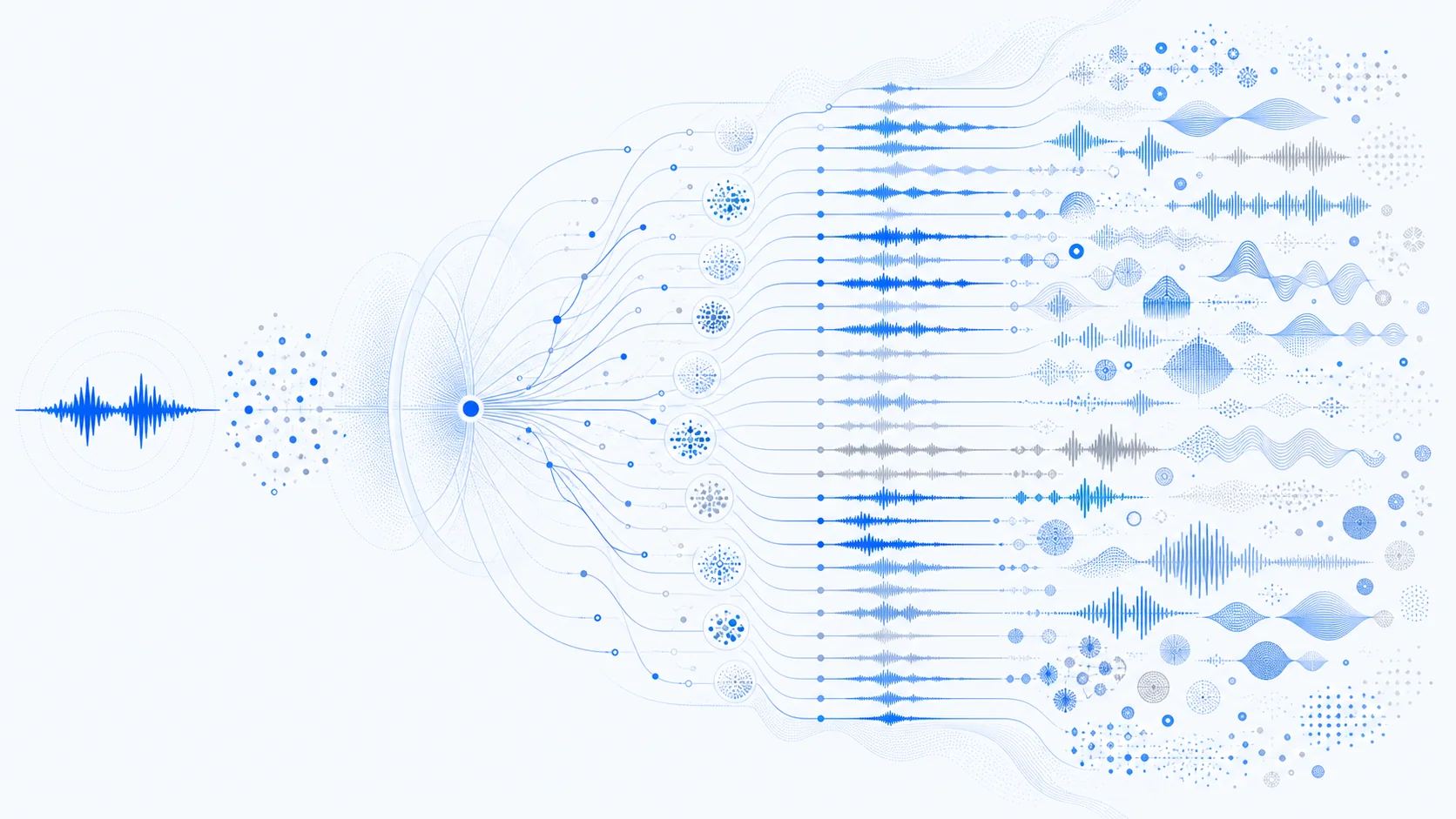
Massively multilingual systems learn shared speech representations across many languages while retaining distinct acoustic patterns.
Self-supervised learning changed the data equation
Supervised learning requires audio with a correct transcript. Self-supervised speech learning can first learn useful sound representations from audio that has no transcript. Labeled examples are still valuable, but the model can extract structure from far more abundant raw speech.
Google's Universal Speech Model research illustrates the approach. Google trained a two-billion-parameter model family on 12 million hours of speech and 28 billion text sentences spanning more than 300 languages, then used smaller amounts of labeled data for downstream recognition. Google described USM as a step toward a 1,000-language initiative, while its demonstrated ASR scope at publication remained above 100 languages.
Massively Multilingual Speech crossed the thousand-language line
Meta's 2023 Massively Multilingual Speech project expanded speech-to-text and text-to-speech to 1,107 languages and language identification to more than 4,000. The project used self-supervised learning plus a dataset built from readings of translated religious texts, averaging about 32 hours for each of the 1,100-plus languages.
MMS was historically important, but its data also demonstrates why headline counts require context. Read religious speech is not identical to spontaneous meetings, street interviews, classrooms, or oral histories. Meta itself discussed the domain and speaker-distribution limitations. Breadth matters; representativeness matters too.
Research crossed the 1,600-language line
Meta's 2025 Omnilingual ASR research pushed the boundary beyond 1,600 languages. The project scaled self-supervised speech pretraining to seven billion parameters and paired it with an encoder-decoder design intended to generalize in zero-shot and low-resource settings.
The researchers report several results that explain why this work matters:
- More than 1,600 languages are covered.
- More than 500 languages had reportedly never been served by any previous ASR system.
- The 7B LLM-ASR system achieved a character error rate below 10 for 78% of the supported languages in the project's evaluation.
- Communities can extend the framework to an unserved language using a small number of paired examples.
- The open model family ranges from compact 300M variants to seven-billion-parameter systems.
The project's open-source repository publishes code, model information, supported-language data, benchmark results, and an inference pipeline. It also makes an important engineering point: a research model is not automatically a finished transcription application. Running a model, managing audio limits, conditioning it on the right language, processing long files, reconstructing timestamps, and delivering an editable document remain product problems.
Watch: Meta AI introduces Omnilingual ASR
This official overview from Meta AI explains the research milestone behind automatic speech recognition for more than 1,600 languages, including the extension path for languages that still lack conventional ASR support.
Video: “Introducing Meta Omnilingual Automatic Speech Recognition” by AI at Meta. This is independent research context showing where multilingual ASR is heading; the next section focuses on the MultiLingual Pro experience itself.
Research milestones help explain what is becoming possible. MultiLingual Pro should be evaluated separately as the complete Speechyou experience users can access today.
What MultiLingual Pro adds
MultiLingual Pro is Speechyou's purpose-built transcription mode for languages outside Whisper's practical coverage and for users who need substantially broader language and script support.
It is best understood as a complete product capability rather than a model name. MultiLingual Pro brings broad transcription coverage together with recording and upload tools, long-file processing, timing, optional speakers, editing, analysis, and export.
It brings several layers together:
- A searchable language catalog. Instead of entering an unfamiliar code, users can browse or search Speechyou's full language directory.
- Automatic model routing. If a selected language is supported by Whisper, Speechyou can keep the faster Whisper workflow. If it is not, the interface switches to MultiLingual Pro automatically.
- Long-recording handling. The production workflow prepares and divides long audio into model-safe segments, processes those segments, and reconstructs one transcript.
- Timestamps. Speechyou aligns transcript passages to the recording so users can navigate, review, and produce subtitles.
- Optional speaker identification. Multi-speaker material can be labeled when speaker diarization is enabled.
- Editable output. The result is a working document, not merely raw model output.
- Downstream analysis. Users can ask for summaries, action items, key points, or answers grounded in the transcript.
- Practical export. Speechyou supports TXT, SRT, VTT, and JSON workflows; its speech-to-text and subtitle page explains the main output paths.
This distinction between technical possibility and product usability is central. A research demonstration can be groundbreaking while remaining inaccessible to a journalist, student, local archive, or researcher who does not operate speech-processing infrastructure. MultiLingual Pro makes broad coverage available through the same record-or-upload workflow used for mainstream languages.
What “1,700 supported languages” actually means
The phrase is intentionally easy to read, but the underlying reality needs more precision.
As of August 21, 2026, Speechyou's live directory says “Browse all 1672 supported languages.” The product rounds that figure to 1,700 in marketing copy. More precisely, the catalog contains approximately 1,700 language-and-script entries.
That wording matters for four reasons.
1. A language and a writing system are different things
Speech is acoustic; a transcript is written. One spoken language can be represented in more than one script. Serbian, for example, may be written in Cyrillic or Latin. Azerbaijani has been written with Latin, Cyrillic, and Arabic scripts. Mandarin output may be expected in Simplified or Traditional Chinese characters.
Speechyou's extended language identifiers generally combine a three-letter language code with a four-letter script code. Conceptually:
eng_Latn  = English, Latin script
srp_Cyrl  = Serbian, Cyrillic script
srp_Latn  = Serbian, Latin script
cmn_Hans  = Mandarin Chinese, Simplified Han script
cmn_Hant  = Mandarin Chinese, Traditional Han script
The exact catalog is designed for users, so the interface shows readable names rather than requiring code knowledge.
The standards behind this pattern are well established. ISO 639 provides internationally recognized language codes. ISO 15924 provides script codes maintained by the Unicode Consortium as the registration authority. The broader internet standard BCP 47 / RFC 5646 explains how language, script, region, and variant subtags can be combined to identify linguistic content.
2. A locale is not always a distinct language
Services often count en-US, en-GB, en-AU, and en-IN as separate supported entries. Those are useful distinctions, but they are regional configurations of English rather than four unrelated languages. Other catalogs count one entry for English and attempt to handle accents within it.
That is why vendor language totals are rarely perfect apples-to-apples comparisons. One provider may count languages, another locales, another language-script pairs, and another model-specific configurations.
Speechyou's number should be read as the size of the selectable transcription catalog—not as a claim to cover 1,700 mutually unrelated standardized languages.
3. A language label may contain many varieties
Even precise codes cannot represent every accent, dialect, sociolect, register, or community convention. A system may support a language while seeing far more broadcast speech than village conversation, more read speech than spontaneous speech, or more speakers from one region than another.
This is particularly important for macrolanguages and dialect continua. The model's output may be useful, but a native speaker should check whether it reflects the vocabulary and orthography expected by the community.
4. “Supported” means available for transcription, not guaranteed perfect
In MultiLingual Pro, a supported entry means Speechyou can accept that language selection and run it through the extended transcription workflow. It does not mean:
- every speaker and dialect was equally represented in training;
- every recording will reach the same error rate;
- automatic language detection will always choose correctly;
- names, places, numbers, or specialist terms will never need correction;
- code-switching will be flawless;
- the transcript is certified for legal, medical, academic, or archival purposes;
- the model replaces a native-language reviewer.
This is not a weakness unique to Speechyou. It is the correct way to interpret probabilistic speech recognition generally.
How Speechyou compares with the public market
The following comparison uses publicly documented language claims available on August 21, 2026. It is directional, not a laboratory benchmark: these products differ in audience, real-time capability, model families, definitions, and language-specific features.
Scroll horizontally to compare all columns.
| Product or model | Publicly documented scope | Important context |
|---|---|---|
| OpenAI Whisper | About 100 languages | The official model card describes 98 non-English languages in transcription training data; performance varies by language. |
| Google Cloud Speech-to-Text | 85+ languages and variants | Google's production page distinguishes this from broader research pretraining across 300+ languages. |
| AssemblyAI Universal | 99 languages | The official support page lists prerecorded-audio coverage; streaming coverage is narrower. |
| Speechmatics | 56+ languages | Its multilingual model emphasizes code-switching within that set. |
| Amazon Transcribe | Feature-dependent language and locale list | Its official table shows that batch, streaming, redaction, custom models, and analytics vary by language, so one headline total would be misleading. |
| Speechyou MultiLingual Pro | 1,672 listed language/script entries, presented as about 1,700 | Browser-based workflow with upload/recording, timestamps, optional speakers, editing, AI analysis, and export. |
Sources: OpenAI Whisper model card, Google Cloud Speech-to-Text, AssemblyAI language support, Speechmatics product information, and Amazon Transcribe's feature-by-language table.
This comparison supports a careful conclusion: Speechyou is one of the very few user-ready transcription products offering selectable coverage at this scale. It does not prove that no other application, self-hosted project, or newly released service can offer broad multilingual recognition. Absolute “only tool” language would age badly in a fast-moving market. The durable differentiator is MultiLingual Pro's combination of breadth and workflow.
How the MultiLingual Pro workflow handles long audio
Research ASR models often have practical input constraints. A meeting or interview cannot always be passed to the model as one uninterrupted two-hour waveform. Splitting audio carelessly, however, can remove context or cut a word in half.
Speechyou's MultiLingual Pro pipeline is designed around that engineering problem.
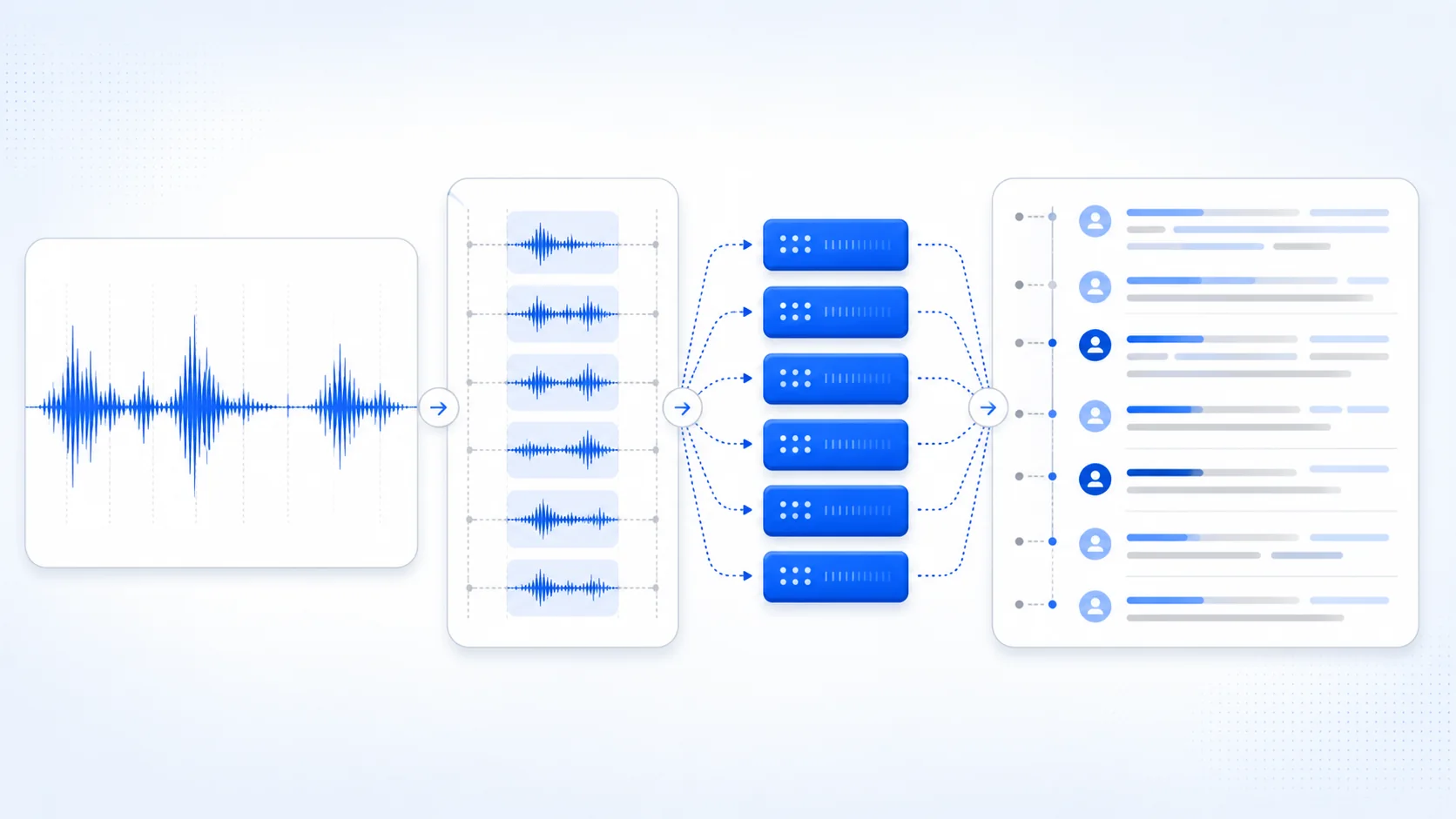
The production workflow preserves continuity across segmentation, recognition, timing, and optional speaker labels.
Step 1: Normalize the media
Uploaded audio and the audio tracks inside video containers can vary in codec, channel layout, sample rate, and metadata quality. Browser-recorded WebM files may even omit reliable duration information.
Speechyou first prepares the recording in a consistent speech-friendly format. Normalization makes duration detection and later splitting more reliable. It also gives the downstream models a predictable mono audio signal.
Step 2: detect silence and choose safer boundaries
The workflow examines the recording for pauses. Instead of cutting mechanically at an arbitrary second whenever possible, it prefers a nearby silence after a useful minimum span. Each segment remains below the model's safe input limit.
This does not make every boundary linguistically perfect. Some speakers pause inside a sentence; others speak through long clauses without pausing. But silence-aware segmentation generally preserves more natural context than fixed cuts alone.
Step 3: transcribe each segment with the selected language
Each prepared segment is sent through MultiLingual Pro with the relevant language-and-script condition. Supplying the intended language is valuable when the user knows it: closely related languages may share sounds and vocabulary, and a short sample may not give automatic detection enough evidence.
Step 4: reconstruct one document
The segment outputs are ordered and joined into a continuous transcript. Speechyou tracks progress across the chunks so longer jobs can show meaningful processing status instead of appearing frozen.
Step 5: align text with time
MultiLingual Pro provides the broad language recognition, while Speechyou's workflow adds speech-aligned timing information. Where detailed alignment data is available, the system distributes the recognized text across detected speech ranges. If detailed alignment cannot be retrieved, it falls back to timing based on the silence-aware audio segments.
This hybrid approach allows the broad transcription mode to participate in timestamped workflows such as playback navigation and subtitle creation.
Step 6: attach speaker information when requested
If speaker identification is enabled, Speechyou determines which detected speaker overlaps a timed text segment most strongly and attaches that label. Diarization answers “who spoke when”; it does not identify a person's real-world name unless the user later assigns one.
Step 7: save an editable, exportable transcript
The completed text, time ranges, optional speaker labels, language selection, and processing metadata become a Speechyou note. From there, the user can review the recording alongside the transcript, make corrections, search the text, ask AI questions, or export it.
This is what makes MultiLingual Pro a product rather than a technical demonstration: it does not stop at generating words; it makes the result stable and useful across the rest of the workflow.
Whisper or MultiLingual Pro: which should you choose?
Broader is not automatically better for every file. Speechyou keeps both modes because they optimize for different needs.
Scroll horizontally to compare all columns.
| Decision factor | Whisper | MultiLingual Pro |
|---|---|---|
| Best starting point | English and other widely supported languages | Languages outside Whisper's list; regional and lower-resource languages |
| Coverage | Roughly 100 languages | About 1,700 language/script entries in Speechyou |
| Typical Speechyou experience | Faster | Usually takes longer; the interface advises roughly two minutes for a typical job |
| Language handling | Auto-detect or select a Whisper-supported language | Search the extended catalog or use automatic selection where appropriate |
| Long files | Supported through Speechyou's transcription workflow | Supported through normalization, silence-aware chunking, reconstruction, and alignment |
| Timestamps | Available | Available through Speechyou's hybrid timing workflow |
| Speaker identification | Optional | Optional through the combined workflow |
| Recommended test | Check names, numbers, terminology, and difficult audio | Also verify script, dialect conventions, and language choice with a competent speaker |
Choose Whisper when:
- your language appears in the standard list;
- turnaround speed matters;
- you are transcribing English or another language on which Whisper is known to perform strongly;
- your testing already shows it meets your needs.
Choose MultiLingual Pro when:
- your language is unavailable in Whisper;
- Speechyou marks the selected language as using Pro;
- the expected script is available in the extended catalog;
- language inclusion is more important than the fastest possible result;
- you are evaluating regional, community, or field recordings beyond the usual commercial language set.
If you are unsure, use a representative sample and compare. Model choice should be evidence from your audio, not loyalty to a model name.
Coverage is not the same as equal accuracy
The most responsible way to explain MultiLingual Pro is to celebrate the coverage breakthrough without turning it into an accuracy guarantee.
Benchmark results describe a dataset, not every future recording
One prominent 2025 research project reported character error rates below 10 for 78% of the languages it evaluated. That is an extraordinary aggregate result across a very broad set. It does not mean every language scores below 10, every dialect within those languages was tested, or every real-world recording—including a MultiLingual Pro job—will reproduce the benchmark.
Benchmarks control many variables. Real recordings introduce:
- phone compression;
- distant microphones;
- music or traffic;
- reverberant rooms;
- speakers interrupting each other;
- children's or elderly speech;
- local vocabulary;
- names and place names;
- mixed languages;
- emotional, whispered, or shouted speech;
- spelling conventions not represented in the reference text.
Error metrics do not tell the whole story
Two common ASR metrics are word error rate (WER) and character error rate (CER).
Both count substitutions, deletions, and insertions compared with a human reference:
Error rate = (substitutions + deletions + insertions) / reference units
WER uses words as the unit; CER uses characters. Lower is better. A score of zero would mean an exact match under the chosen normalization rules.
WER is intuitive for languages where words are separated predictably by spaces. It becomes less comparable across languages with rich morphology, compound formation, or writing systems without ordinary whitespace segmentation. The 2025 NAACL paper “Advocating Character Error Rate for Multilingual ASR Evaluation” argues that CER is often more consistent across writing systems and may correlate better with human judgments in multilingual evaluation.
Even CER has limits. A one-character error can completely change a name or number. Conversely, several character differences may reflect an acceptable spelling variant rather than a meaningful failure. For practical work, automatic metrics should be combined with native-speaker review and task-specific checks.
One number can hide unequal language performance
An average across hundreds of languages can conceal excellent results for some and weak results for others. It can also hide differences by dialect, gender, age, region, domain, or recording condition.
This is why Speechyou does not assign one guaranteed accuracy percentage to every MultiLingual Pro language. The useful question is not “What is the universal accuracy?” There is no honest universal number. The useful question is “How does it perform on material that resembles my real workload?”
How to evaluate a language responsibly
If a transcription matters to a project, run a small evaluation before committing a large archive or workflow.
Build a representative sample
Select at least 10–30 minutes that contains the difficulty of the real material, not only the cleanest passage. Include:
- more than one speaker if the collection has multiple speakers;
- the accents or dialects you expect;
- both quiet and noisy sections;
- natural speed and hesitation;
- names, dates, numbers, and key terminology;
- code-switching if it occurs in the real recordings;
- the microphone and file format used in production.
For a large project, use several samples across speaker groups and recording environments.
Create a trusted reference
Ask a competent speaker to transcribe the sample according to an agreed convention. Decide in advance:
- whether to preserve fillers and false starts;
- how to spell dialect forms;
- whether punctuation is evaluated;
- how numbers are written;
- how borrowed words are represented;
- which script is expected;
- how unclear passages are marked.
Without a consistent reference, an error score can measure disagreement between annotators rather than model quality.
Score more than raw words
Use a scorecard suited to the project:
Scroll horizontally to compare all columns.
| Dimension | What to inspect | Why it matters |
|---|---|---|
| Content fidelity | Missing, added, or substituted meaning | Determines whether the transcript represents the recording |
| Names and entities | People, places, organizations, products | Often carry more practical importance than ordinary words |
| Numbers | Dates, prices, measurements, phone numbers | Small errors can have large consequences |
| Orthography and script | Expected spelling system and characters | Essential for search, publication, and community acceptance |
| Dialect treatment | Preserved local form versus unwanted normalization | Affects authenticity and linguistic analysis |
| Speaker labels | Correct changes and consistent labels | Important for interviews and meetings |
| Timing | Text aligned closely enough for navigation or captions | Important for quotation checking and subtitles |
| Editing effort | Minutes of review per recorded hour | Often the most useful production metric |
Separate error severity
Not every correction has the same impact. Consider classifying errors:
- Cosmetic: punctuation, capitalization, or a harmless spacing difference.
- Recoverable: a wrong word that is obvious from context.
- Material: a changed name, number, negation, quotation, or factual statement.
- Critical: an error that could create harm in a high-stakes decision or published record.
This makes the evaluation more useful than one aggregate score.
Compare models on the same material
If the language is available in both modes, transcribe the identical sample with Whisper and MultiLingual Pro. Compare content, editing time, script, timing, and turnaround. A model with a slightly better benchmark may still be worse for a specific domain or accent.
Google's FLEURS benchmark is useful research infrastructure—it provides around 12 hours in each of 102 languages—but no public benchmark can replace a project-specific test across nearly 1,700 configurations.
Where broad language coverage matters most

Broad speech recognition can make community recordings more searchable, but consent, local expertise, and human review remain essential.
Oral history and community archives
Oral-history collections often contain precisely the material mainstream ASR handles least well: elderly speakers, regional varieties, mixed languages, historical vocabulary, imperfect archival audio, and languages with limited digital text.
MultiLingual Pro can produce a first-pass searchable transcript, help reviewers navigate by timestamp, and create a starting point for cataloging. It should not silently normalize community speech or replace the authority of speakers and language experts. Used carefully, it can reduce mechanical transcription time and let experts focus on interpretation, correction, and context.
Linguistic and anthropological research
Field researchers may collect interviews, narratives, elicitation sessions, and spontaneous conversation. Broad initial coverage can help triage recordings, locate recurring terms, or prepare rough working transcripts.
But research use also exposes the limitations most clearly. Fine phonetic distinctions, tone, morphology, code-switching, and non-standard orthography may require specialist annotation. Recent fieldwork research emphasizes that spontaneous speech, environmental noise, and tiny datasets remain difficult even for modern multilingual models.
Journalism and documentary production
A journalist may need to search an interview before a native-language editor completes a publication transcript. Timestamps and optional speaker labels make it easier to return to the source audio and verify quotations. For publishing, every quote, name, date, and potentially harmful statement should be checked against the recording by a qualified reviewer.
Speechyou's YouTube transcription workflow and SRT subtitle generator can help turn reviewed interviews into caption files.
Education
Students and educators may work in a national language, a regional language, or both. Lecture transcripts can support review and search, while subtitles can make recorded material easier to navigate. Coverage at this scale also matters for researchers studying languages that are rarely available in classroom technology.
The transcript should still be checked before it becomes an assessment record, official accommodation, or source of quoted academic evidence.
NGOs and public-interest organizations
Organizations working across regions may collect community consultations, interviews, training sessions, and field reports in languages omitted from mainstream tools. A first-pass transcript can improve discoverability and reduce the need to listen linearly to every recording.
The organization remains responsible for consent, safe access, retention, translation quality, and the consequences of any decisions based on the transcript.
Media, captions, and searchable archives
Audio becomes more useful when people can find a passage, quote it, translate it, or add captions. Speechyou supports VTT captions for web video as well as SRT and plain-text output. Broad transcription coverage can bring more local-language media into search and accessibility workflows, provided the final captions are reviewed for reading speed, segmentation, spelling, and timing.
Global teams
Most meeting transcription products are designed around a relatively small set of corporate languages. MultiLingual Pro extends the same note workflow to more regional and national languages. Teams can preserve the original-language transcript, then create summaries or selected translations without discarding the source text.
Responsible use for oral history and community language data
The fact that software can process a recording does not determine whether it should.
Obtain meaningful permission
Recording consent and processing consent are related but not always identical. A speaker who agreed to an interview years ago may not have agreed to cloud processing, automated analysis, public subtitles, or model development. Archives and researchers should review the original agreement and the expectations of the community.
Consent should be understandable in the speaker's language and should explain:
- what will be recorded;
- where it will be processed and stored;
- who can access the audio and transcript;
- whether AI tools will be used;
- whether the result will be published;
- how corrections or withdrawal requests are handled;
- how long the files will be retained.
Treat language data as community data when appropriate
Open-data norms do not automatically override collective rights and cultural protocols. The CARE Principles for Indigenous Data Governance emphasize Collective Benefit, Authority to Control, Responsibility, and Ethics. They complement technical open-data principles by centering people, purpose, power, and self-determination.
Local Contexts provides Traditional Knowledge and Biocultural Labels through which Indigenous communities can express expectations about provenance, access, permission, and future use. These frameworks are relevant whenever recorded language includes community knowledge, culturally restricted material, or collective interests that an ordinary copyright checkbox cannot capture.
Preserve the source and the correction history
An AI transcript is a derived interpretation. Keep the original audio, document the selected language and script, preserve corrections, and identify who approved the final text. If orthography is contested or evolving, record the convention used rather than presenting it as the only valid form.
Do not confuse transcription with preservation
Speech technology can assist documentation, search, subtitles, and access. It does not by itself keep a language alive. Language vitality depends on speakers, intergenerational transmission, education, cultural authority, daily use, and community-led institutions.
UNESCO estimates that around 1,500 languages could lose their users in the near future. A transcript can support community goals, but the community—not the model—defines those goals.
How to get a better transcript
Language coverage cannot compensate fully for poor input. A few recording choices often improve results more than switching models repeatedly.
Before recording
- Put the microphone close enough to the speaker to capture a strong voice signal.
- Reduce echo by using a smaller furnished room rather than a large empty space.
- Turn off nearby music, fans, televisions, and notification sounds where possible.
- Record separate microphones or channels for speakers if the setup allows it.
- Confirm the intended language and writing system with participants.
- Ask how names and specialist terms should be spelled.
- Obtain the appropriate permission before recording or uploading.
Speechyou provides a free browser voice recorder for simple captures. For important field or archival work, use the best original recording available and keep an uncompressed master when practical.
When configuring the transcription
- Select the known language instead of relying on auto-detection for a short or ambiguous clip.
- Choose the expected script variant.
- Use MultiLingual Pro when Speechyou marks the language as requiring it.
- Enable speaker identification only when the recording contains multiple speakers and the labels add value.
- For difficult material, transcribe a short sample first.
During review
- Listen to uncertain passages rather than guessing from the generated text.
- Verify names, numbers, negations, and direct quotations first.
- Check whether the system normalized local speech into a standard form.
- Review speaker changes around interruptions and overlapping talk.
- If making subtitles, review timing and line breaks as well as words.
- Ask a competent speaker to approve material intended for publication or research citation.
For code-switching
Code-switching remains difficult because the model must recognize not only two languages but the moment of transition, shared names, borrowed vocabulary, and the spelling convention for each span. Research on Yoruba-English code-switching and bilingual fieldwork continues to find that adaptation and representative data matter.
If a recording switches languages frequently, include that pattern in the evaluation sample and expect additional review. Do not infer strong code-switching performance merely because both languages appear independently in the catalog.
From transcript to useful output
Recognition is only the first stage. Speechyou is designed to keep the original-language transcript useful after processing.
Edit and verify
Review the transcript while playing the source audio. Correct the passages that matter, assign meaningful speaker names if appropriate, and preserve the original recording for later verification.
Search and analyze
Once speech becomes text, users can search for a name or topic instead of scanning an entire recording. Speechyou's Ask AI tools can create summaries, identify action items, extract key points, and answer questions grounded in the note. Generated analysis should be checked against the transcript, and the transcript should be checked against the audio for consequential claims.
Create subtitles
Export SRT for broad compatibility with video editors and platforms, or VTT for web video workflows. Timestamps reduce setup work, but good captions also require readable line lengths, sensible breaks, speaker cues where needed, and human review.
Translate after preserving the source
Transcription and translation are different tasks:
- Transcription: speech in language A becomes text in language A.
- Translation: text in language A becomes text in language B.
Keep the source-language transcript as the authoritative working layer, then translate from the reviewed version. This prevents translation errors from hiding recognition errors.
Continue into voice production when needed
Some workflows move in the opposite direction after editing: a reviewed script needs narration, localized audio, or an accessible spoken version. In that case, a text-to-speech platform such as Verbatik can turn finalized text into generated speech. Treat the generated voice as a separate production stage and confirm that the selected language, pronunciation, and permission model suit the project.
Frequently asked questions
What is MultiLingual Pro?
MultiLingual Pro is Speechyou's broad-coverage transcription mode for approximately 1,700 language-and-script options. It combines extensive language availability with a production workflow for long audio, timestamps, optional speaker labels, editing, AI analysis, and export.
Is MultiLingual Pro a replacement for Whisper?
No. The two modes are complementary. Whisper is usually faster and remains an excellent choice for English and many widely supported languages. MultiLingual Pro extends coverage far beyond Whisper's roughly 100-language range. Speechyou can route a selected language to the appropriate mode automatically.
Does Speechyou support exactly 1,700 distinct languages?
Speechyou uses 1,700 as a rounded product figure. At the time this article was published, the live language directory listed 1,672 entries. Some entries distinguish the same language written in different scripts, so “about 1,700 language-and-script configurations” is the most precise short description.
Why do scripts count separately?
A speech model must return written text. When a language has more than one writing system, selecting the intended script changes the expected output. Serbian Cyrillic and Serbian Latin, for example, are distinct transcription configurations even though they represent the same language.
Is every supported language equally accurate?
No. Accuracy depends on training-data representation, dialect, speaker characteristics, domain vocabulary, audio quality, script and orthographic conventions, and benchmark coverage. MultiLingual Pro makes the language available; users should test representative audio and use competent human review where accuracy matters.
What does the cited research result of “CER below 10 for 78% of languages” mean?
It means the researchers measured fewer than 10 character-level edits per 100 reference characters for 78% of the languages in their benchmark under a specific normalization setup. It is industry context, not a MultiLingual Pro accuracy promise. It does not mean 78% of future Speechyou recordings will have the same score, nor does it guarantee the remaining languages meet a particular threshold.
Can Speechyou automatically detect the language?
Speechyou offers automatic detection, but selecting a known language can improve reliability—especially for short recordings, related languages, ambiguous speech, or a specific script requirement. Automatic detection should be tested rather than assumed flawless.
Can MultiLingual Pro handle long interviews and meetings?
Yes. Speechyou prepares long recordings, finds useful pause boundaries, processes model-safe segments, reconstructs the text, and attaches timing information. Processing time depends on recording length, queue conditions, and the selected model.
Can it identify speakers?
Speechyou offers optional speaker diarization. It separates speakers into labels based on when they talk. Diarization does not inherently know that “Speaker 1” is Maria or “Speaker 2” is David; users can interpret or rename labels during review.
Does support for a language include every dialect?
Not necessarily. A language entry may cover multiple varieties unevenly. Dialect boundaries are also social and linguistic questions that cannot always be represented by one code. Test the actual speaker population and involve community reviewers.
Does MultiLingual Pro translate speech directly?
Its primary job is transcription: preserving speech as text in the source language and selected script. Translation is a separate downstream action. Keeping the two stages separate makes errors easier to identify and correct.
Can I use the result as a legal, medical, or official record?
Do not treat an unreviewed AI transcript as certified evidence or professional documentation. Requirements vary by jurisdiction and field. For consequential use, preserve the audio, maintain an audit trail, obtain appropriate consent, and use qualified human review.
Can MultiLingual Pro help preserve endangered languages?
It can support community-led documentation, search, captions, and transcription, but software alone does not preserve a language. Communities should control the goals, permissions, orthography, access rules, and final text. Follow relevant governance frameworks and involve speakers at every stage.
How do I try it?
Browse the supported-language directory, choose a representative recording, and start through Speechyou's plans and trial options. Begin with a short sample, verify it with a competent speaker, and expand only after the workflow meets the project's needs.
Conclusion
Whisper made robust multilingual transcription practical for a broad public. MultiLingual Pro addresses the next, much larger problem: the thousands of languages left beyond the normal product menu.
The achievement is not merely a larger dropdown. It is the combination of:
- more than 1,600-language ASR research;
- approximately 1,700 selectable language-and-script configurations;
- automatic routing between fast mainstream transcription and broad-coverage transcription;
- processing for long recordings;
- timestamps and optional speaker labels;
- editable, searchable text;
- summaries and transcript-grounded questions;
- TXT, SRT, VTT, and JSON export.
At the same time, language coverage must be described honestly. A listed language is an opportunity to test and use the system, not a guarantee that every dialect, microphone, speaker, or domain will behave identically. The right standard is representative evaluation, transparent limitations, respect for language communities, and human review proportional to the consequences of an error.
For many people, MultiLingual Pro removes the oldest barrier in speech technology: being told that their language is not supported at all. That does not finish the work of inclusive speech recognition. It makes far more of that work possible.
Explore all supported languages or start transcribing with Speechyou.
Research and standards referenced
- Omnilingual ASR: Open-Source Multilingual Speech Recognition for 1600+ Languages — Meta AI
- Introducing Meta Omnilingual Automatic Speech Recognition — AI at Meta video
- Omnilingual ASR open-source repository — Meta Research
- Introducing Whisper — OpenAI
- Whisper model card — OpenAI
- Robust Speech Recognition via Large-Scale Weak Supervision — OpenAI paper
- Introducing speech-to-text for 1,100+ languages — Meta Massively Multilingual Speech
- Universal Speech Model — Google Research
- FLEURS: Few-shot Learning Evaluation of Universal Representations of Speech — Google Research
- Common Voice datasets — Mozilla Data Collective
- A Survey of Multilingual Models for Automatic Speech Recognition — ACL Anthology
- Advocating Character Error Rate for Multilingual ASR Evaluation — ACL Anthology
- Breaking the Transcription Bottleneck for Extremely Low-Resource Fieldwork Languages — ACL Anthology
- ISO 639 language codes — International Organization for Standardization
- ISO 15924 script codes — Unicode Consortium
- RFC 5646 / BCP 47 language tags — RFC Editor
- Glottolog language catalog information
- Multilingualism and linguistic diversity — UNESCO
- CARE Principles for Indigenous Data Governance — Global Indigenous Data Alliance

