
Oral History Preservation
Corsican elders often share stories and traditions orally. Speechyou transcribes these recordings into searchable text, safeguarding the language for future generations.
Prepare a transcript draft from Corsican audio or video, then review the text alongside your recording.
An account is required. Choose your file in the app after signing up or signing in.
Continue to Speechyou to upload your Corsican audio or video.
or drop a file here
MP3, WAV, M4A, MP4 and more
Continue to signup. Your file stays on your device; choose it again in the app after creating your account.
No file is uploaded on this page.
Work with your recording after transcription: review the text, find the passage you need and prepare it for the next step.
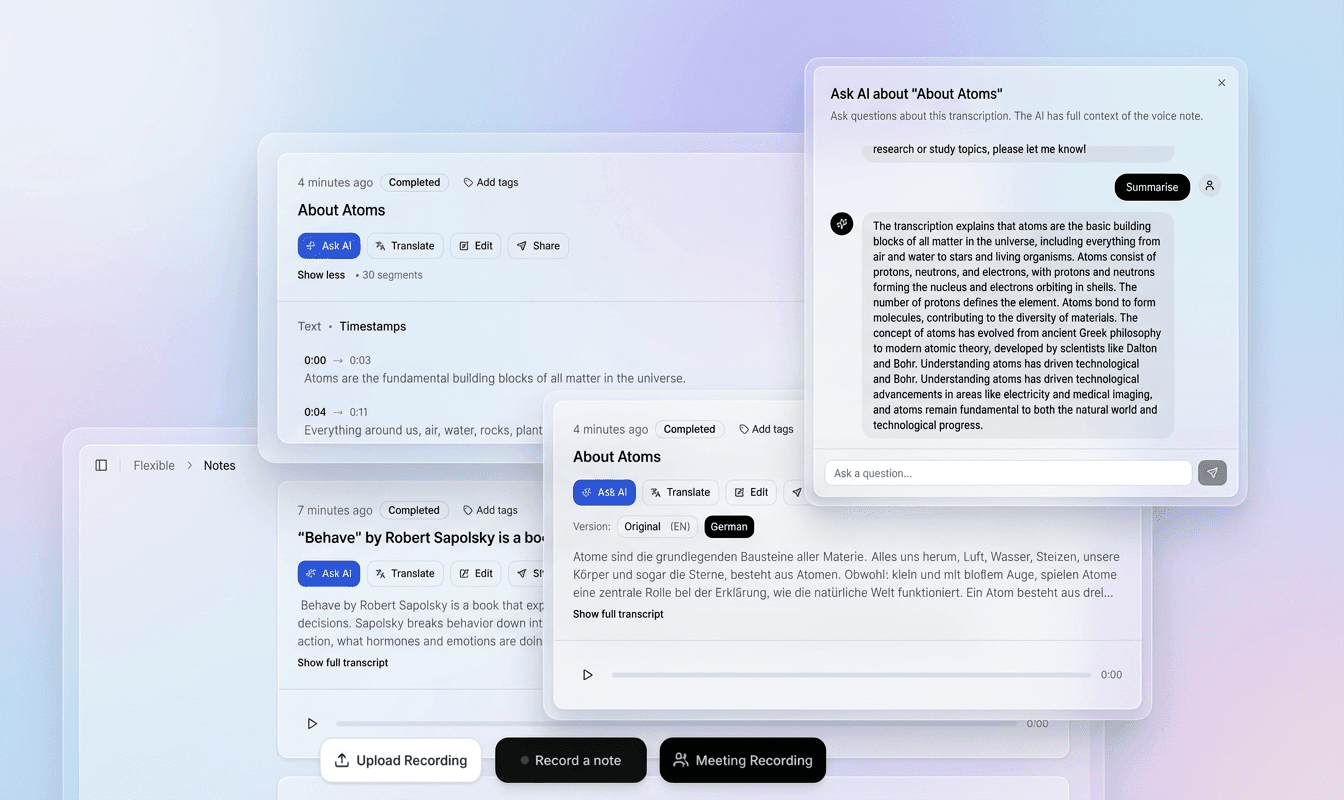
Use the recording and timestamped text together to check names, unfamiliar words and speaker changes in context.
Correct the transcript in the editor, refine segments and prepare a version that fits your document or video.
Export plain text, structured data or subtitle files. Use the transcript for notes, research, captions and follow-up work.
Choose a file above to continue to signup. Your recording stays on your device at this step.
In the app, choose your file again, select its spoken language and model, then start transcription.
Check the draft against your recording, correct the text and timing, then export the format you need.
Regional speech and spelling conventions matter. Identify the variety in your recording and check an excerpt before committing a larger project.
Review Corsican audio alongside a draft transcript, keeping the speaker’s vocabulary distinct from similar Italian or French forms.
Results depend on the recording, selected model and language variety. Review names, specialist terms and unclear passages before sharing or publishing.
Check familiar-looking Italian or French forms against the actual words spoken.
Review regional forms and place names consistently across the recording.
Review accents and language-specific letters. Check that similar-looking Cyrillic characters have not entered Latin words when editing or copying text.
What to listen for when reviewing the first draft.
Corsican is a low-resource language with few large transcribed datasets. Check familiar-looking Italian or French forms against the actual words spoken. Review regional forms and place names consistently across the recording.
Northern and Southern Corsican differ significantly in pronunciation and vocabulary. Regional Corsican pronunciation and vocabulary need review in their own context. When working with Cismontano (Northern Corsican), Pumuntincu (Southern Corsican), Corsican of the Cap Corse region, keep the speaker’s wording and check unfamiliar forms with a fluent reviewer.
Corsican uses diacritics (è, ò, ù, etc.) that are essential for correct spelling. Check Corsican spelling against the recording and the writing convention used by your project. Review names, diacritics and unfamiliar word forms before exporting; a page’s script label does not replace checking the actual written output.
Many Corsican speakers mix French into their speech. For mixed-language Corsican recordings, mark each language change during review and check borrowed words and names against the audio. Correct any passage that has been normalized into the wrong language.
Practical ways to turn a recording into material you can search, edit and reuse.
Corsican elders often share stories and traditions orally. Speechyou transcribes these recordings into searchable text, safeguarding the language for future generations.
Corsican-language podcasts gain wider reach with draft transcripts for review and subtitles, making them accessible to both Corsican learners and the global audience.
Corsican films and documentaries often require subtitles in Corsican and other languages. Speechyou generates SRT/VTT files quickly, preserving the cultural nuance.
Linguists studying Corsican dialectology can transcribe field recordings automatically, saving hours of manual work and enabling quantitative analysis.
Work from a saved Corsican audio or video recording in the online app. Review the resulting transcript and export SRT or VTT captions for your video; this describes a recorded-file workflow.
Learners of Corsican can practice by listening to audio and reading the AI-generated transcript side by side, improving both listening and reading skills.
After transcription and review in the app, choose the output that fits your next step.
Corsican (Corsu) is a vibrant Romance language spoken on the island of Corsica and in the diaspora. Despite its rich cultural heritage, Corsican faces the threat of language shift toward French. Automatic speech-to-text technology offers a lifeline by making Corsican content more accessible, searchable, and shareable. Check Corsican spelling against the recording and the writing convention used by your project. Review names, diacritics and unfamiliar word forms before exporting; a page’s script label does not replace checking the actual written output.
Corsican is the historical language of Corsica, an island in the Mediterranean under French administration. It is also spoken in parts of northern Sardinia (the Gallura region) and among Corsican diaspora communities in mainland France, the United States, and Canada. The language has two main dialect groups: Cismontano (north) and Pumuntincu (south), along with transitional varieties.
For a language with limited digital presence, speech-to-text opens up new possibilities. Podcasters can reach a wider audience by providing transcripts. Filmmakers can subtitle documentaries in Corsican and other languages. Linguists can transcribe field recordings without spending weeks on manual work. Educators can create accessible learning materials. Perhaps most importantly, oral histories—an irreplaceable repository of Corsican culture—can be preserved in a durable, searchable text format.
Corsican presents several challenges for automatic speech recognition:
Corsican-language podcasts are a growing medium for culture and news. Transcribing episodes with Speechyou creates show notes, searchable archives, and subtitles for video versions. Listeners who are hard of hearing can follow along, and learners can use the transcript as a study aid.
Corsican filmmakers produce works that are screened at international festivals. Subtitling in Corsican (for local audiences) and in other languages (for global reach) can use Speechyou's SRT and VTT export.
Researchers can then analyze vocabulary, syntax, and phonetic variation.
Speechyou transcribes them automatically, generating text that can be indexed, searched, and quoted. This is critical for revitalization efforts, as younger generations can access these stories in a familiar text format.
Work from a saved Corsican audio or video recording in the online app. Review the resulting transcript and export SRT or VTT captions for your video; this describes a recorded-file workflow. This makes content accessible to the deaf and hard-of-hearing community while also improving SEO and viewer engagement.
Learners of Corsican can use the transcription feature to practice listening comprehension. By reading the AI-generated transcript alongside the audio, they can catch unfamiliar words and improve their pronunciation.
Whether you are a cultural activist, a researcher, a podcaster, or a filmmaker, Speechyou empowers you to transcribe Corsican audio with ease. Our Solo plan includes unlimited transcription, so you can process as many hours as you need without worrying about per-minute costs. Sign up and start converting Corsican speech to text after processing.
Q: Can I transcribe Corsican audio that is not perfectly clear? Listen to a representative section before processing a long Corsican recording. Background voices, music and distortion can obscure words; keep uncertain passages marked for review and compare them with the original audio. However, for best results, we recommend using a good microphone and minimizing ambient sounds.
Q: How do I export subtitles in Corsican for my video? A: After transcription, go to the captions tab, choose SRT or VTT format, and download.
Q: Is there a limit on audio file length? A: The Solo plan supports files up to 2 hours long. For longer files, you can split them or contact us for enterprise options.
Q: Can I edit the transcript after it is generated? A: Yes, the Speechyou editor allows you to correct any mistakes, adjust timestamps, and add speaker labels. The final transcript can be exported in your preferred format.
Speechyou is committed to supporting endangered and minority languages. By providing accurate, affordable, and easy-to-use transcription, we help Corsican speakers and learners keep their language alive in the digital age.
Practical details before you start.
Check Corsican spelling against the recording and the writing convention used by your project. Review names, diacritics and unfamiliar word forms before exporting; a page’s script label does not replace checking the actual written output. Check familiar-looking Italian or French forms against the actual words spoken.
For mixed-language Corsican recordings, mark each language change during review and check borrowed words and names against the audio. Correct any passage that has been normalized into the wrong language. Select the main recording language in the app and check the other-language passages separately.
Regional Corsican pronunciation and vocabulary need review in their own context. When working with Cismontano (Northern Corsican), Pumuntincu (Southern Corsican), Corsican of the Cap Corse region, keep the speaker’s wording and check unfamiliar forms with a fluent reviewer. Start with a short representative sample before processing an archive, and do not assume identical recognition quality across varieties.
Check Corsican spelling against the recording and the writing convention used by your project. Review names, diacritics and unfamiliar word forms before exporting; a page’s script label does not replace checking the actual written output. Check familiar-looking Italian or French forms against the actual words spoken.
Definitely. Speechyou is ideal for oral history projects because it processes long audio files efficiently and produces searchable text. You can then add timestamps and export the transcript for archiving or analysis.
Upload common supported audio formats such as MP3, WAV, M4A, AAC, OGG or FLAC, or video formats such as MP4, MOV or WEBM. Video transcription uses the audio track. Open your account first, select the recording language in the app, and review the result before export.
No. Preserve Corsican wording. Any translation or adaptation into Italian should be a separate document or editing step.
Review the latin script text and check that it matches your project’s writing convention. Any transliteration or translation should be an explicit editing task; the page name alone is not a guarantee of automatic conversion.
No. Choosing or dropping a file takes you to signup. The landing page does not upload, store or transcribe it. After creating your account, select the file again in the app and choose the spoken language and model.
The app accepts MP3, WAV, AAC, OGG, FLAC and M4A audio, plus MP4, WEBM, MOV, M4V and MPEG/MPG video. The free trial and Solo support files up to 10 GB each. You can extract or trim a short section first to evaluate the result.
In the app, review and edit the transcript before exporting. Use TXT for plain text, SRT for video editors and YouTube, VTT for web captions, or JSON for structured data. Check subtitle timing and line breaks against the original video before publishing.
Create an account to transcribe in the app. Solo includes uploads up to 10 GB per file and $15/month or $67/year billing.
Full access with monthly billing.
Choose the language and writing system that match your recording.
Create your account, upload your file in the app and turn your audio into a transcript you can review.