
Oral heritage
Prepare corrected text for interviews, stories and community collections.
Prepare a transcript draft from Aghul (Cyrillic script) audio or video, then review the text alongside your recording.
An account is required. Choose your file in the app after signing up or signing in.
Continue to Speechyou to upload your Aghul audio or video.
or drop a file here
MP3, WAV, M4A, MP4 and more
Continue to signup. Your file stays on your device; choose it again in the app after creating your account.
No file is uploaded on this page.
Work with your recording after transcription: review the text, find the passage you need and prepare it for the next step.
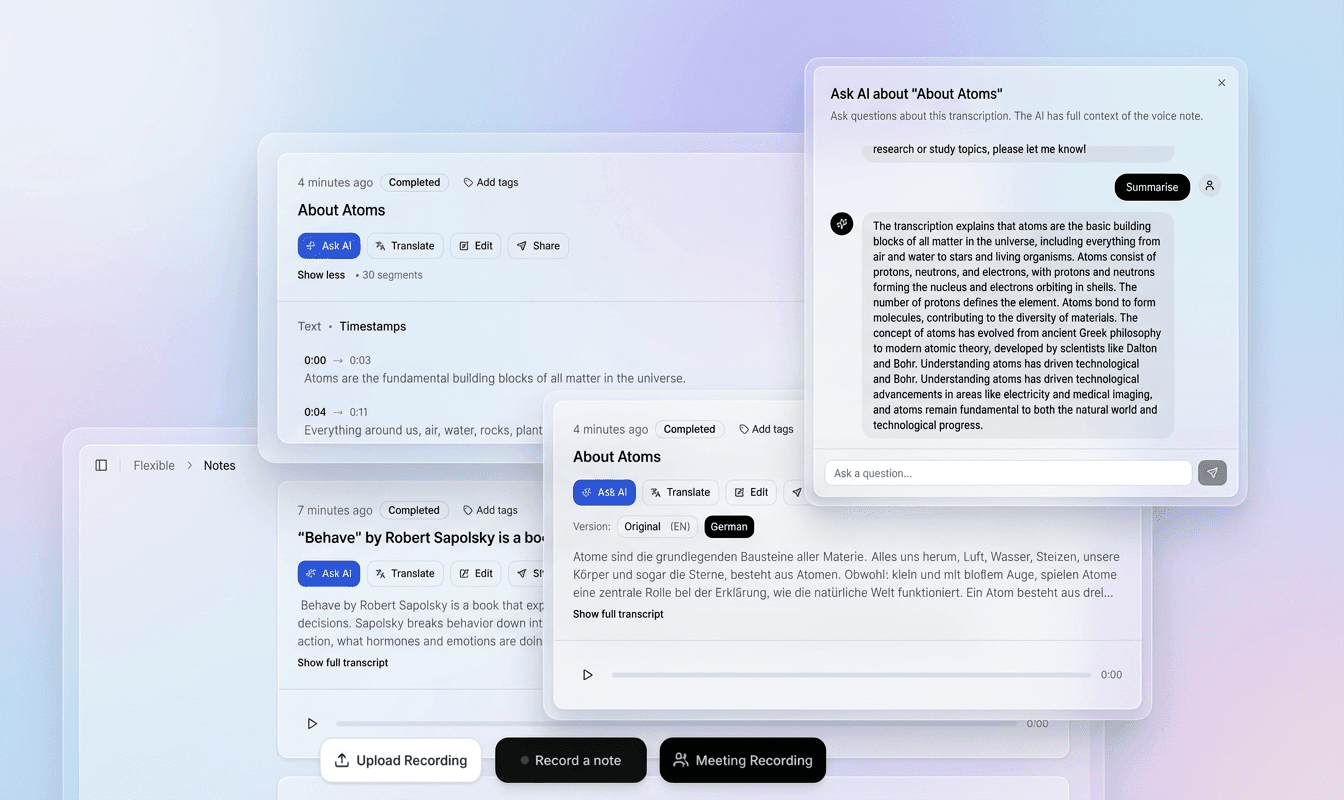
Use the recording and timestamped text together to check names, unfamiliar words and speaker changes in context.
Correct the transcript in the editor, refine segments and prepare a version that fits your document or video.
Export plain text, structured data or subtitle files. Use the transcript for notes, research, captions and follow-up work.
Choose a file above to continue to signup. Your recording stays on your device at this step.
In the app, choose your file again, select its spoken language and model, then start transcription.
Check the draft against your recording, correct the text and timing, then export the format you need.
Regional speech and spelling conventions matter. Identify the variety in your recording and check an excerpt before committing a larger project.
Prepare Aghul recordings with a reviewer familiar with the spoken variety and the Cyrillic spelling required for your text.
Results depend on the recording, selected model and language variety. Review names, specialist terms and unclear passages before sharing or publishing.
Keep locality and speaker context with the file so unfamiliar forms can be checked without guessing.
Review personal names and Cyrillic spelling against the audio and the project’s references.
Review language-specific Cyrillic letters and names. Check for Latin characters accidentally mixed into Cyrillic words when editing or copying text.
What to listen for when reviewing the first draft.
Review Aghul Cyrillic spelling with someone familiar with the chosen writing convention.
A small geographical area can still contain meaningful differences in local speech.
Replay quiet speech, overlapping voices and unfamiliar names against the source recording. Retain uncertainty notes where needed, and check the exported text or captions before publication.
Practical ways to turn a recording into material you can search, edit and reuse.
Prepare corrected text for interviews, stories and community collections.
Create reviewed captions and reading companions to recorded lessons.
Keep searchable transcripts for recorded broadcasts and field interviews.
After transcription and review in the app, choose the output that fits your next step.
Aghul (агъул чIал) is a minority language indigenous to the Agulsky District in the Republic of Dagestan, Russia. Recordings may come from Tpig, Khpyuk, Burkikhan, Fite or surrounding communities. Aghul belongs to the Northeast Caucasian language family. This page concerns Cyrillic transcription, with the written convention and local vocabulary reviewed by someone familiar with the recording.
Many community recordings have value beyond their first audience: an interview may document names, stories and expressions that are useful to later readers. A checked Aghul transcript can be kept with the audio in an archive or prepared as captions for a recorded video.
Review Aghul Cyrillic spelling with someone familiar with the chosen writing convention. Consonant combinations, local names and words that occur only once in an interview deserve particular attention. A familiar-looking spelling should still be checked against what the speaker actually said. Practical review should concentrate on what can actually be heard and how the project’s reader expects it to be written.
Practical details before you start.
No measured percentage is established on this page. Assess a representative recording from your own speakers and review the draft before publishing or expanding the project.
Record clear speech when possible, reduce overlapping voices, keep names and places in a project glossary and ask a knowledgeable reader to review difficult passages.
Open the Speechyou account flow, sign in or create an account, and upload the recording there. This landing page describes the workflow; it does not process a file directly.
The confirmed choices described here are TXT, SRT, VTT and JSON. Review the downloaded file. Test SRT or VTT in the intended video player and check the caption wording, timing and line breaks.
Review it against the recording first, particularly names, numbers, local wording, script-specific characters and language changes. Keep unresolved passages identifiable rather than substituting a confident guess.
Retain the speaker and locality information when available, plus the project’s spelling references, so uncertain words can be checked in context.
Review the cyrillic script text and check that it matches your project’s writing convention. Any transliteration or translation should be an explicit editing task; the page name alone is not a guarantee of automatic conversion.
No. Choosing or dropping a file takes you to signup. The landing page does not upload, store or transcribe it. After creating your account, select the file again in the app and choose the spoken language and model.
The app accepts MP3, WAV, AAC, OGG, FLAC and M4A audio, plus MP4, WEBM, MOV, M4V and MPEG/MPG video. The free trial and Solo support files up to 10 GB each. You can extract or trim a short section first to evaluate the result.
In the app, review and edit the transcript before exporting. Use TXT for plain text, SRT for video editors and YouTube, VTT for web captions, or JSON for structured data. Check subtitle timing and line breaks against the original video before publishing.
Create an account to transcribe in the app. Solo includes uploads up to 10 GB per file and $15/month or $67/year billing.
Full access with monthly billing.
Choose the language and writing system that match your recording.
Create your account, upload your file in the app and turn your audio into a transcript you can review.